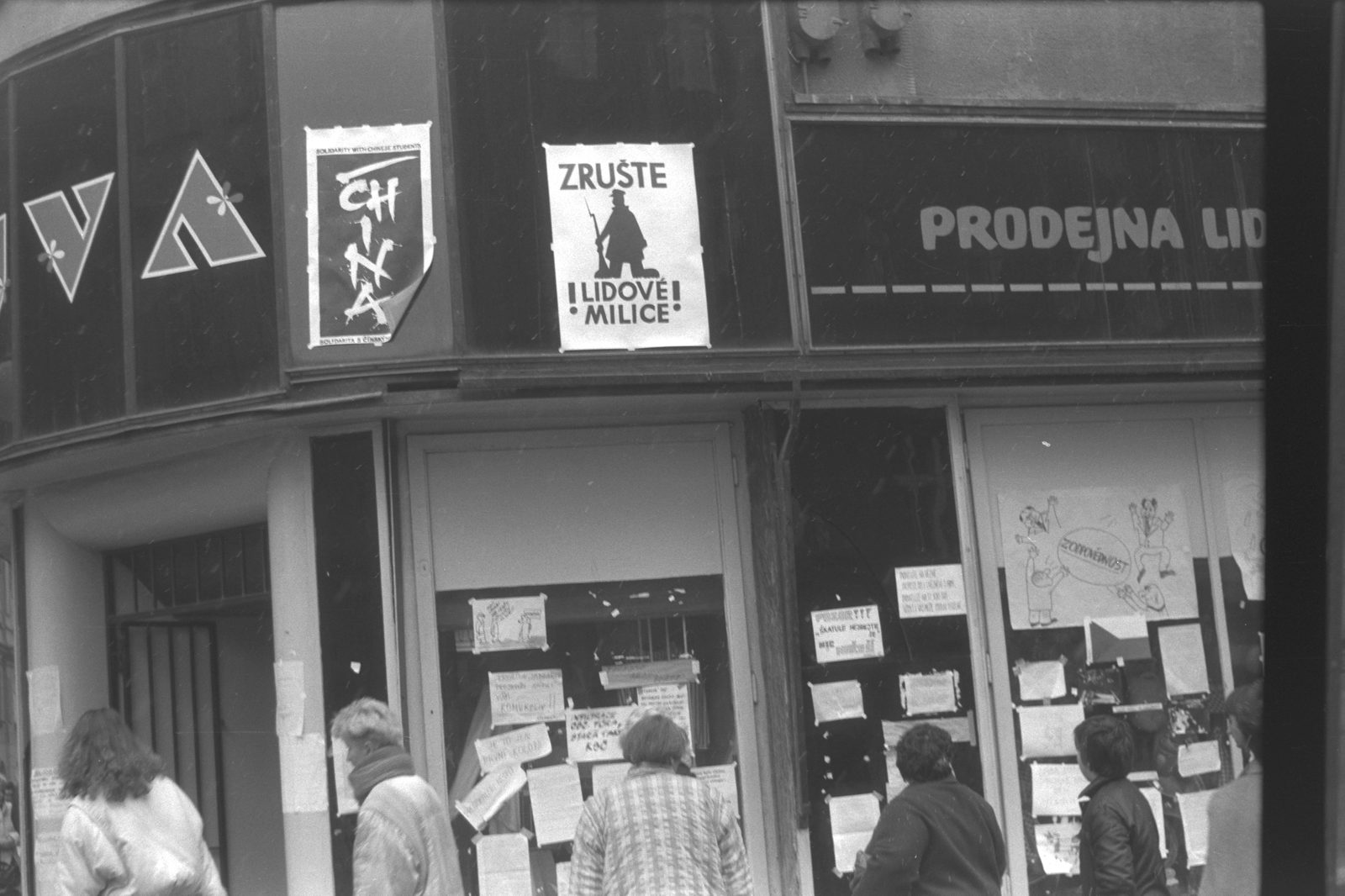
 Brno, November 1989 — "Zrušte Lidové milice" (Abolish the People's Militia). Referenced directly in this interview.
Brno, November 1989 — "Zrušte Lidové milice" (Abolish the People's Militia). Referenced directly in this interview.
Brno, November 1989 — "Zrušte Lidové milice" (Abolish the People's Militia). Referenced directly in this interview.
I think we can tell you something from our point of view — from the students' point of view.
That's what I'm interested in.
You want to?
Yeah. I think the most important thing I can tell you is that we had a big part in this — we were on the local organisation committee at the university. They organised all the work, the students, all the activities. From the beginning, we were like small soldiers — we were on the streets, you know, at the demonstrations.
And of course — ladies just keep working. It doesn't matter. There's no problem at all. [Acknowledging movement around the table.]
Half a year. Starting in November.
Starting in September?
No — we started on the 19th — the 17th was a Friday, I started on Monday. I remember exactly because the 17th was a Friday, and we started Monday evening at the university.
I remember we were sitting in the IC office together and all the students gathered out in the menza [the dining hall] — in the dining room. It was very natural. People wanted to know what had happened. Some speakers — speakers from Prague — we have to support them. So let's join them. Because everything started in Prague, but it spread to the other universities very quickly. Many students from Prague went out to visit other cities to tell them what happened in Prague, to inform the other students. And it happened on Monday in Žilina.
Where is that in comparison to —
It's in Slovakia. Northern Slovakia. It's the third biggest city in Slovakia — about 100,000 people. It's a big university city. I think there were 6,000 students in the situation. Žilina is a historical centre of northern Slovakia.
They visited other cities because there was a communication barrier. No one knew exactly what had happened. So they did this work — from other students. Because we weren't sure what had happened exactly. One thought this, one thought that. The TV and all mass media was under the communist influence. We just knew that something had happened in Prague — from the radio: from Voice of America and Radio Free Europe. From the broadcasting — because we could mainly hear from that broadcasting what really happened.
And you took that as the truth? You trusted those sources?
Yeah. And mainly I trusted the Prague students who came to us. One or two of them came on Monday, and they told us what happened in Prague. So we should join them.
Was there any resistance to it?
Yes, there was some resistance. Many students were afraid — they were afraid to attend the meetings, afraid not to attend school. We had maybe three subjects at school which learned us that the communist system is good — you must believe in the communist system, and you have the wrong way if you don't believe in it. Many things were impossible to say to me, to the teachers in the school.
It was funny — because on Monday I had a normal study in the book. Just an ordinary day. And we had a class in political economy.
Take me through the week.
Monday was this big gathering in the student dining hall, and people just didn't know what to do. On Tuesday we didn't go to school. A minority went to school. We stayed in the student dormitory and waited for what was going to happen.
What percentage would you say?
Oh — I don't know. 80% from the beginning. From the beginning, 80%. [Were afraid.]
I think the third day, Wednesday, we met. We did this march through the main square and back.
Which square?
There is the main square in Žilina. Plenty of squares. It was quiet. We were announced — if there was anything loud, there were police, and there were some passengers — the firemen — they were ready, they were waiting for us.
I'm still curious about the committee. You were elected to your position?
It was one year on the WBORU. [The student union or faculty council.] I worked on this first committee. I was starting before the 22nd. The committee changed several times during the process of the revolution.
Why?
Because it was very quick. People didn't know how to do it. Some people couldn't do it. Some didn't have organising abilities — others appeared more capable. It changed the structure.
So it wasn't as if the police were coming in and —
No, no, no. The students themselves changed the committee.
And on Wednesday, the first day, we started to put posters on the walls — to inform people. Because we were the only group of people in Czechoslovakia who knew about these problems — these things about the revolution, what happened in Prague. We had to inform other people — what we were going to do, what had happened, and our plans.
And was there a counter-propaganda going on?
Yeah. The government was really strong against that. On TV, they just said it: "It's a big anti-communist power" and so on.
With the army?
No — not with the army. The police could have taken 20 people to prison, and all the rebellion would have finished. Because 80% of the students were afraid.
From one reason, it was a danger — because we had some agreement with the military high school — military university — at Liptovský Mikuláš. [The Vojenská akademie — the Czechoslovak military academy in Liptovský Mikuláš, Slovakia.]
I think the main problem in the government was that the people at the top of the government, at the top of the country, didn't know what to do. Some people said "you must be ready, except for example —" Nothing. Nobody told them to do it. Only said "do not be ready."
Public militia?
Militia. Armed workers. You know — in every company there was this special sort of people, armed workers, who were trained to defend or prevent the communist system. And they were hard communists. If something happened, they would be used in the action. They had automatic guns, and they were well-organised. So there was another dangerous part which could be used — even against the army. They had emergencies declared. They had instructions, they were maintained to start the war against the students.
And the police?
Police didn't act. But until this time I still don't understand why they didn't use the police.
Were they like younger? Or older?
No, no. The background of the police was middle-aged people. Not only young people — most of them had children who were studying. They didn't know what to do.
When did the people join you? Specifically, when did the workers join?
The workers? I think when we announced the general strike. One week and a half. In the second week.
How did you establish a strike committee in a factory?
It's only the thing you have to do. In the whole, I think most factories — there was one or two people, or five people, who wanted to do it. Most were OK. If we came to the factories, there were five people who were sympathetic — speak, come to me, and we can do it.
They came to you?
Some people from the shops, from the factories, came to the Žilina VPN studio office — and others waited for us. There was a parade — wait for us, wait for some events to start this strike.
After the first week, the students were on site, and after the second week the workers started to come on site too.
Was this getting greater airtime on TV?
Yeah — it was strange. TV from time to time started to change its mind, to an independent position. In the first week they were strictly communist. But after, they were independent — just monitoring what was going on. It was nice that they stopped the propaganda against the students. They were just monitoring the situation.
From the Western standpoint, we saw a lot of things happening through the Civic Forum and through Havel and so on. I realised that the students played such an impact, and I was curious as to how communications went around. So Prague sent out people to the different university towns, and then the students then took the information and took it to the people?
Yeah — the nuclear reaction. We organised, through the local organisation committee at our university, trips to the villages by bus. I went on a lot of them. In every village there was a stop — two students went out from the bus and talked to the people. The bus went on. On the way back, they collected the students.
Even with the confusion, they were inclined to believe the students?
Yeah, they were. Because you know, really many people were sick of communism. So it was better to believe.
We had a video cassette from 17 November — and all the images showed it.
How did you get this video?
It was very quick. I think we got it within a few days. Somebody knew — there were many universities all over, this art university — CNN — there was some work of work. But we had a few students with this video.
In the small towns?
Yeah, everywhere. We used all channels — all possible channels — to inform people about what had happened and what was going on. This picture from CNN and others — restaurants, delivery — anywhere. This was our only chance to get people on our side. Ordinary people didn't know what was going on.
So two people would be dropped off in a village?
Yeah — two or three.
And what would you do then?
Speak with the starosta — the mayor.
Mayor?
Starosta — Mayor. If we met somebody and he was interested in it, we explained to him, we put up the posters — and we talked to him whether he wanted to base the Civic Forum in the village or not. We could help them by — if they wanted to base a Civic Forum, to start some revolution in the village. Because we wanted them to take active part. So almost everywhere was organised some Civic Forum — by the companies in the cities, and in the villages. Mainly organised by the students from the strike committees.
But when you say Civic Forum — it's not in the sense that it's a party?
No. It was Civic Forum — some organisation committee. The local conversation committee.
The way I associate the Civic Forum as a sort of entity — it's not in the literal sense. The Civic Forum is Havel and this gang.
Yeah, OK. After some time, the Civic Forum was organised as a single association. But in the beginning it was really natural groups of people who wanted to change something.
So a week and a half has gone by, two weeks has gone by — people are inside, the revolution is consolidating.
Yeah, approximately. It was the end of November. We still didn't go to school. We were on strike — still on strike — until the end of January or something like that.
What happened after?
There was something in the Communist Party — they wanted to elect new leadership of the party. After that there was a process of negotiation of some of the hypothetical goals. The main process was in Prague. The leadership of the Civic Forum negotiated with the government. There were some changes in the leadership of the Communist Party — a new leader was elected, and some changes in the government at that time.
Were you in those negotiations?
Yes. With the director and the academic council — economic council — yes.
You must have sensed a shift in the power, right? Suddenly there is momentum. Suddenly you have more people behind you, more support. And now you can make stronger demands?
Yeah, sure. Because in fact the leadership of the university was afraid of the students at that time. Because at that time the students had unlimited power and could do any changes. So they tried to behave according to our demands, and changes in the individual community — [committee] — were done after a few weeks.
And how about the teachers? Were they with you?
Some teachers supported us. Ordinary teachers — professors — supported us. Of course the communists were not — because it was the same situation in the university as in the whole state. The main part were communists.
What happened after that? When did things solidify?
There was a fight, I think — if I'm not mistaken — in the communist government. They fought, the leaders of the Communist Party fought each other. Jakeš was replaced. [Miloš Jakeš, last General Secretary of the Czechoslovak Communist Party, resigned 24 November 1989.]
Now, what do you think — four years after?
It's very interesting to see from that side. From my personal point of view — when it began, I really didn't expect what would happen. I really thought there would be just some reform of communism.
One of the reasons the government didn't do anything is because they were scared. In '68 they had the Soviet Union behind them. Now in '89, the Soviet Union was not coming back — and so they were simply scared. They didn't want to make a move against the people because they knew the people would be against them. Is it that simple?
It can be one of the reasons. The other one — they had some secret plans to get it with the Civic Forum, that they would join the government some way. Maybe they had some promises.
What kind of ideology, what ideological lessons did you learn in high school, or public school, or university, that tried to persuade you that communism was — something good?
Sure, sure. I was 16 in the gymnasium — you know, high school. Občianska výchova [civic education], civil defence, branná výchova [defence training]. There were some exams. I don't remember what was in English. When we had to know how to protect our lives — what we had to know.
[To kill?]
To kill — by shooting. OK, it was like just a game. They were like, "Let's find a game." They just played — just shot, just to throw the anger out. Because we couldn't understand how we can kill people. Because this is, like, our mission — we have to protect communism from the small — [from the small enemy]. Everyone was, like, beaten through your head.
What did you do to counter it?
You know, people — it was very funny. I tried — because my father didn't believe in the system. He was a driver.
When she says "you have to," that doesn't mean you have to join the Party. It just means you have to pretend you understand?
Pretend.
Or pretend you agree.
Pretend.
And now have you spoken with him about it?
No, no. I didn't speak with him about why he entered.
Is he still in the Party?
No — he's not. Immediately after the revolution, he gave up. But I think he had to enter. He had big problems with the Communists at that time. But he was like a normal man. He had problems, and they gave him a chance: "Your son will enter the university, or you will go on with your activities." He did it for his family.
Did you learn about Charter 77? Did you learn about Havel? Did you come across any material, any books?
We read it only through Western radio stations. Havel — a writer against the Communists. Charter 77 — they exist, they fight against the government, they are wanted by the government.
How about organisations like the Jazz Section?
They were bigger in the '70s than the '80s. There weren't a lot of channels to get it, you know. The most possible was in Prague — but if you were in Žilina, it's quite far from there. The more you are far, the harder it is.
I spoke with a few people, and they said that one person in ten, one person in seven — whoever — would inform the secret police.
We had one guy in our class. We lived in a block of flats, in student hotels. On every floor there was one guy who was connected with the Communist Party.
And you always knew who he was?
Yeah. On our floor we knew. He was quite strange — but in the end, he was good. He didn't tell anything about us. We told the communists "wrong" and so on — but he didn't do it normally.
Some people from the government found that students are at the right point. If you are 19, 20, 21 — a young guy — no problem. If you take a look back to the past, you can find that almost all revolutions began by students. This is the three-part generation. They didn't have any bonds — [ties] — zaľazky bulldog — [Slovak for ties, attachments] — no bonds. Only to their parents.
Your parents were worried about you being involved in that?
My parents — "It's very simple. People need to do something. They know something when they know them." My parents were very afraid when I went into the area. I did activities in the revolution. "Please don't go there. You have so many problems. Please don't go there. Don't be somewhere in your room. Don't go away anywhere."
Before — before — actually, these people must — somewhere in Czechia, in Banská Bystrica, in Prague, the State Police have some archives, some place — in this place, a documentary place — they had the names of all the agents of the StB.
Now? [1993–94, Mečiar is then PM of independent Slovakia.]
Yeah — Mečiar. He was in secret police. The Czech newspaper claimed that the Slovak police don't want to agree that — but there are witnesses who proved that he was working with them. His nickname [allegedly his StB code name] — "Doktor [unclear surname]".
And this is the fear?
Yeah — it was fear. They have an emotional power. They can do anything.
In some books — you know, Mňačko is a very good writer. [Ladislav Mňačko, 1919–1994, Slovak Jewish dissident author of The Taste of Power and Death Is Called Engelchen; one of the major Slovak dissident voices.] You can see him in some English translations.
Did you guys join the Pioneers? Almost everybody was in the Pioneers, right?
Everybody. You had to go there.
It was a very funny situation. We had problems — in my village — [in the school yard] — concrete — 20 metres and 40 metres — this monument — "Saved Pioneers" — with the guns — saved monument — only the children with real guns.
[Switching topic.] With a communist boss — what should I ask him? What are your questions?
I have some ideas of my own, but I was wondering what he would do. It's a local committee — what he did in 1989, of course. Why he's still communist. Why? What's the reason? They are sitting around.
- Vysoká škola dopravy a spojov (VŠDS) in Žilina — now the University of Žilina (UNIZA); the technical university where Dusty was a student
- Žilina — third-largest city in Slovakia (after Bratislava and Košice); northern Slovakia
- Vojenská akademie, Liptovský Mikuláš — the principal Czechoslovak military academy in Slovakia; the "military university" Dusty refers to as a backstop
- Verejnosť proti násiliu (VPN) — Public Against Violence — the Slovak counterpart to the Czech Civic Forum (Občanské fórum). In Slovakia, the November 1989 movement was VPN, not OF. Dusty and the second speaker use "Civic Forum" loosely as a generic term, but the Slovak movement they were organising in was VPN.
- Lidová milícia / Ľudové milície — the People's Militia, the Communist Party's armed worker auxiliary; politically reliable, well-armed, separate from the army and police. A real and credible threat in November 1989 — that they did not act is one of the defining mysteries of the Velvet Revolution that Dusty identifies.
- Miloš Jakeš — last General Secretary of the Czechoslovak Communist Party; resigned 24 November 1989
- Vladimír Mečiar — three-time Prime Minister of Slovakia (1990–91, 1992–94, 1994–98); allegations of his prior StB connections were a major Slovak political controversy in the 1990s and were never fully resolved
- Ladislav Mňačko (1919–1994) — Slovak Jewish dissident author; The Taste of Power (1967), Death Is Called Engelchen (1959); emigrated after 1968
- Sviečková manifestácia — the Candle Demonstration of 25 March 1988 in Bratislava, a Catholic-led peaceful protest brutally suppressed by water cannons and arrests. Major precursor to November 1989 in Slovakia, and the moment Slovak Catholic civil society organised itself. Dusty references it obliquely in the lunch-break section about the Catholic dimension.
- Iskra ("Spark") — youngest Communist youth organisation, ages 6–9
- Pionieri / Pionýři (Pioneers) — Communist youth organisation, ages 9–15
- SSM — Socialistický zväz mládeže / Socialistický svaz mládeže — Socialist Union of Youth, ages 15–26
- Branná výchova — mandatory school subject combining civil defence, military preparation, and shooting practice
- Smaženica (Slovak) / smažený sýr — Slovak fried-cheese dish ordered partway through the interview
- The political-economy teacher who never taught again (Section 4). One Monday class, one challenge from her students about the events in Prague — and her career as a teacher of political sciences ends that day. "She never taught later." The smallest possible unit of regime collapse, captured in a single afternoon.
- "We put the posters on our bodies" (Section 8). The image is one of the most cinematic in the entire series — students typing on manual typewriters for 24 hours straight, the secret police pulling posters down from walls, and the students' response: wear the posters. Combined with the Brno theatre actor-couriers (Interview 04) and the village bus drops (Section 14 below), this is the operational anatomy of how information moved during a revolution without computers or fax machines. Strong candidate for a stand-alone short-form piece.
- The village bus drops (Section 14). Two students dropped at every village, the bus goes on, picks them up coming back. They speak with the starosta, put up posters, set up the local Civic Forum / VPN cell. The hyperlocal mechanics of a national revolution. Pairs with Scherhaufer (Interview 04) and the math teacher (Interview 02) on village-versus-town information diffusion.
- The military academy backstop at Liptovský Mikuláš (Section 10). The agreement that if the regime cracked down, military-academy students would join. This detail does not appear in any of the Czech interviews and is a genuinely Slovak operational element. Worth verifying with surviving members of the Žilina student strike committee or with Slovak Velvet Revolution historians.
- The "white berets" / bílé barety description of the riot police (Section 11). The specific subgroup deployed against demonstrators were "young men who studied in political schools," distinct from the regular middle-aged police force whose own children were university students. This sociological detail explains the asymmetry between regime threat and regime restraint.
- The mass exodus from the Party — "we never had anything to do with the Communist Party" (Section 17). The single-week reversal of 1.3 million Party members claiming they had never really been Communists. Pairs editorially with Mr. Salát's interview (Interview 06), where Salát is the man who didn't take his card back — and whose wife paid for it.
- "I appreciate my father — he said: 'Run if something'" (Section 25). The father who was a Communist Party member but, when his son went to the demonstrations, told him to run if there was trouble. Not "don't go." This is the same emotional register as Interview 02's father telling his daughter not to wear heavy shoes. Across two interviews, two fathers from different generations and different sides of the political divide, both giving the same practical advice to their children.
- "I think in your life — in life — one time is a true point. You must change all of this, and you must go, and you must move. I think it's only one time in your life." (Section 25.) Dusty's compressed account of what it felt like to be 19 in November 1989. The single sentence that the studio could quote on a wall.
- The Mečiar-as-StB-agent claim (Section 26). Politically explosive, partially supported by evidence, never fully resolved. Treat with the same investigate-the-system-not-the-statement discipline as Mr. Salát's secret-services thesis. Dusty is reporting what was credible in Slovakia in the early 1990s; whether or not the claim is true is a separate question from the political reality that many Slovaks believed it.
- The bayonet-equipped Pioneer monument (Section 28). A statue of Pioneer children with real machine guns and bayonets at his village school. Vivid, period-specific, surreal. Worth seeing whether the monument still stands or what happened to it after 1989 — would be powerful B-roll for an Anabasis piece on the militarised childhood of late-communist Czechoslovakia.